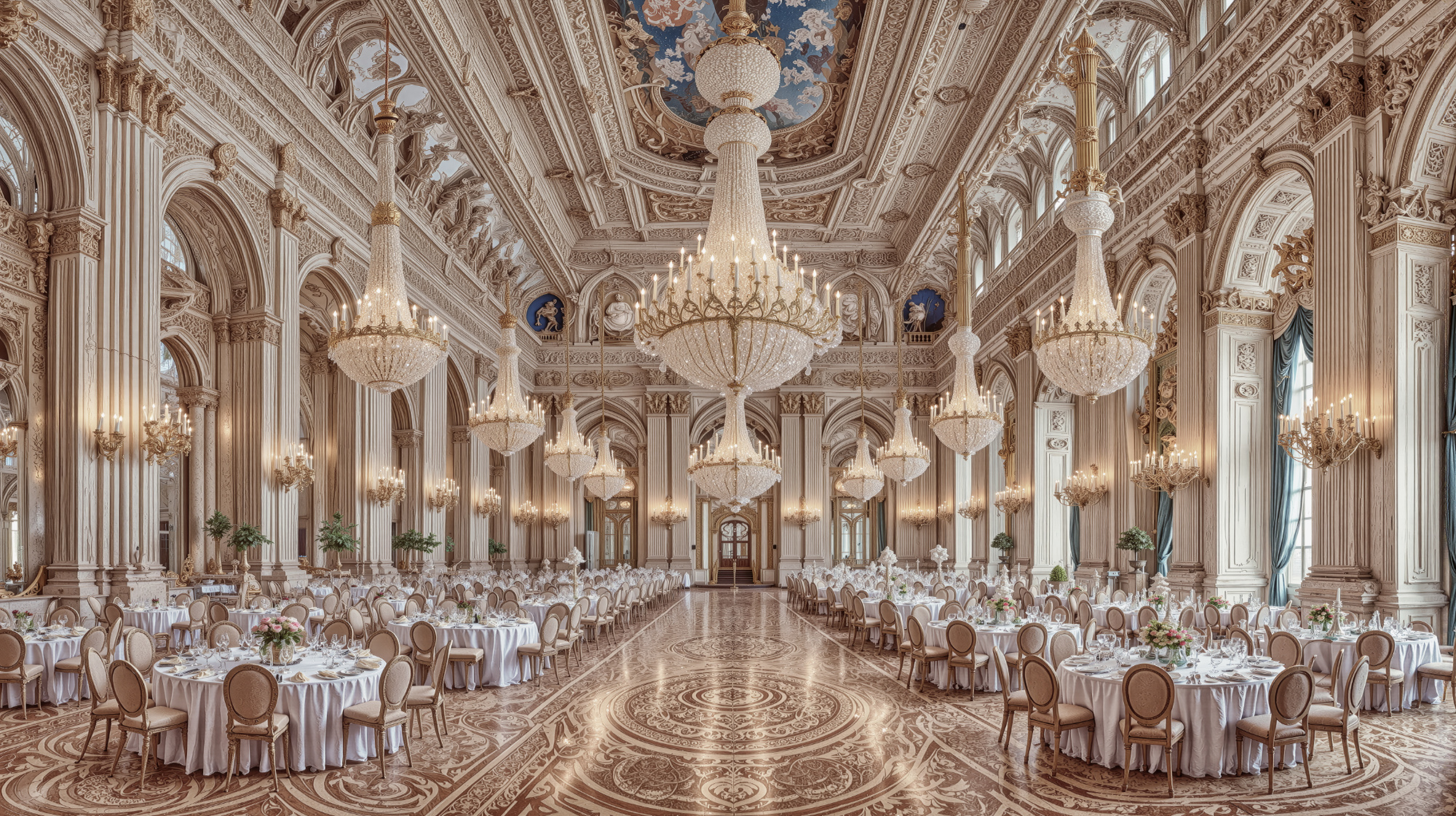
One day a king proclaimed he would build the biggest, most beautiful ballroom in all the world.
"People will visit from far and wide to eat and dance in this place."
The king was very pleased with himself.
"Everyone in my kingdom will be happy!"
But not everyone is happy...
The king gathers his advisors.
"Let us talk about my ballroom."
The king invites each to speak. The first begins with an air of confidence.
"The ballroom shows your good taste."
Then the second, with a reassuring glint in his eye.
"You see what so many fail to see."
The third advisor speaks.
"The ballroom will be a place to make agreements. The days of squabbling politics are over. There will be no more need to agree to anything elsewhere."
The king is delighted.
"I would like everyone to know how prosperous and powerful we all are by sharing the very best of our comfort, food, music, and of course..."
The king smiles to his advisers.
"My company."
His advisers bow dutifully as the king concludes.
"Everyone in my kingdom will be happy."
But not everyone is happy, for the very best comfort, food, and music will only be offered to those who are invited.
The king gives instructions to begin building the ballroom immediately. He turns to the rich people that stand beside him.
"I have decided I would like the ballroom bigger, and that it should be built there, beside my palace."
The king points to a building that is over a hundred years old, and where many work tirelessly for the benefit of all. The building is full with history and spirit.
In three days the old building is no more.
Far away from the gaze of the people the king is talking.
"I want to hear what you have said once more."
"You are strong."
The king listens intently:
"Continue."
"You are smart."
"Smarter than anyone you know?"
"Yes, Your Majesty."
The king smiles as he closes his eyes, turns a full circle in the empty room, then asks in his loudest, most kingly voice:
"Is there anyone who does not think me so?"
As work begins on building the ballroom, the king looks over the water from his kingdom to the next. He turns to his advisor and says:
"I do not care for the way they live. We should help them. They have beautiful forests, full with the tallest trees that are wasted where they stand. We need them for my ballroom. Send for my generals."
The king is thinking...
"What pattern do you prefer? The white marble with streaks of green? Or the emperador marble with its intricate veins?"
The general is confused.
"How does this help our neighbours?"
"They will attend the grand opening celebration! So, what is your preference for my ballroom floor?"
As the general searches for a reply, the king's family enter.
The king turns to his children.
"I have a present for you."
The queen and children look silently at one another.
"Our neighbour across the water will show you the most wonderful sight of the tallest trees on earth..."
The king continues excitedly:
"You will be the last to see them. This is my gift to you."
The king smiles.
"The trees will soon be ours, and they will keep the ballroom warm for the whole winter!"
Everyone is quiet except for the king who declares.
"Am I not the most generous, kind-hearted, peaceful king that has ever lived!"
One year later the king stands by an open window of his completed ballroom. Enormous crystal chandeliers hang from the ceiling, and luxurious chairs surround tables that are set for a thousand guests.
The king asks a little bird who is perched out of reach.
"Where is everyone?"
The bird tweets.
"Your generals are at war, your advisors have fled, the rich are making their money far away, and your family have moved to safety."
The king roars:
"Find me guests to cheer for me! To celebrate me! To honour, ME!"
The bird flies away, and the king is left alone for the rest of his days.
. . .
Mike de Sousa is a content philanthropist who creates social and environmental publications, music, literature, and art.
Mike's work is available at Art Lover VIP, and you are welcome to visit Mike's Personal Site where you can discover more about him.
A critical analysis of the short story The Big Beautiful Ballroom, interpreting the narrative as a complex political allegory about authoritarianism and environmental exploitation.
By examining the protagonist (the King) through the lens of pathological narcissism, this study demonstrates how personal psychological fragility within leadership manifests as systemic tyranny, the erasure of historical continuity, and the predatory extraction of natural resources. The analysis argues that the ballroom functions not merely as a setting, but as a physical manifestation of the authoritarian ego, ultimately revealing the inevitable isolationist collapse inherent in regimes built upon vanity and coercion.
Political theory often examines the structure of the state, but literature possesses the unique capacity to examine the psyche of the statesman. In the short story The Big Beautiful Ballroom, the narrative structure serves as a grim trajectory of a dictatorship, moving from the consolidation of power to imperialist expansion, and finally to desolation. While the story adopts the guise of a fable, its undercurrents suggest a rigorous critique of authoritarian governance fuelled by the specific psychopathology of its leader.
This analyses of the text is through two primary lenses. First, it examines the psychological profile of the King, (defined by vanity, grandiosity, deep-seated insecurity, and a lack of empathy) to show how personality in leadership shape political policy. Second, it explores the political and environmental consequences of this psychology, specifically the transition from domestic repression to external resource extraction (ecocide).
The Big Beautiful Ballroom illustrates that authoritarianism is fundamentally a project of vanity that necessitates the destruction of both cultural heritage and the natural world to sustain the fragile ego of the leader.
The central engine of the narrative is the King’s psychology, which aligns closely with narcissism. The story opens with a declaration of intent to build the "biggest, most beautiful ballroom," a clear indicator of grandiosity. However, the text quickly subverts the idea of a benevolent ruler.
The scene in which the King retreats to a private room to demand affirmations from an unseen sycophant (or perhaps himself) exposes the core of the authoritarian psyche: insecurity. The dialogue: "You are strong... You are smart... Smarter than anyone you know?", reveals that the King’s external projection of power is a defence mechanism against an internal void. In political theory, this reflects the fragility of the dictator who requires a 'Cult of Personality' not just for control, but for emotional regulation.
The King’s subsequent turning a "full circle in the empty room" symbolises the solipsism of the tyrant; reality only exists as a reflection of his own desire.
Furthermore, the King displays himself as impulsive and with a lack of empathy, traits essential to the maintenance of totalitarian power. His definition of happiness is projected onto the populace ("Everyone in my kingdom will be happy"), yet he remains completely detached from their actual needs. This psychological blindness allows him to interpret his own desires as the 'General Will' of the people, an often used justification in authoritarian regimes to suppress dissent.
Politically, the story maps the process by which authoritarian regimes dismantle civil society to erect monuments to the state. The pivotal moment occurs when the King orders the destruction of a building that is "over a hundred years old, and where many work tirelessly for the benefit of all."
Symbolically, this old building represents the 'Public Commons', historical continuity, and democratic institutions. It is a place of utility, history, and communal spirit. Its destruction in "three days" to make way for the ballroom serves as an allegory for the erasure of history and the dismantling of social welfare systems. The advisor’s chilling comment that "The days of squabbling politics are over" signals the end of pluralism. In an authoritarian system, political debate ("squabbling") is replaced by enforced consensus. The ballroom is intended to be a place where agreements are performative, effectively ending the democratic process.
The King’s decision to place the ballroom "beside my palace" and share his "company" as the ultimate commodity highlights the centralisation of power. The state is no longer a servant of the people; the people are props in the theatre of the King’s life.
As the narrative expands beyond the kingdom's borders, the allegory shifts to critique the relationship between authoritarian expansionism and environmental destruction. The King’s gaze across the water introduces the theme of resource imperialism. His justification: "I do not care for the way they live. We should help them"; parodies the rhetoric of 'Civilising Missions' or 'Liberation Wars' often used to mask resource theft.
The environmental critique is stark. The neighbouring trees are described as "wasted" because they exist in nature rather than serving the King’s aesthetic whims. This reflects a utilitarian, capitalist-extractive view of nature where the environment has no intrinsic value. Nature is viewed of as merely a means to achieving an end that supports the personal and political comfort and advantage of those with power.
The King’s interaction with his general highlights the 'Banality of Evil'. While the general prepares for war, a violent act of aggression, the King is obsessed with the aesthetics of "white marble with streaks of green". This dissociation illustrates the king's utter disregard for others and nature as an extreme example of lacking empathy; human life and ecological stability are secondary to the patterns on a floor.
Most disturbingly, the King frames this ecocide as a "gift" to his children: "You will be the last to see them." This is a profound moment of intergenerational theft. The King is aware he is destroying a non-renewable resource ("the tallest trees on earth"), yet he frames their extinction as an exclusive spectacle. This serves as a piercing allegory for the current climate crisis, where political elites pursue short-term luxury and power at the cost of the planetary future they leave to their descendants.
The story concludes with a temporal jump to "One year later," revealing the inevitable entropy of the authoritarian system. The ballroom is complete, yet empty. The bird’s report: that the generals are at war, the advisors have fled, and the rich, departed; maps the systemic collapse typical of late-stage dictatorships: brain drain, capital flight, and perpetual conflict.
The ending serves as a critical evaluation of the 'Great Man'. The King, roaring "Find me guests to cheer for me!", is left with the ultimate reality of his psychology: absolute isolation. The "big beautiful ballroom" is revealed to be a mausoleum.
The story The Big Beautiful Ballroom utilises the fairy tale format to strip complex geopolitical dynamics down to their psychological roots. By juxtaposing the construction of a luxury aesthetic (the ballroom) with the tearing down of functional heritage and nature, the story argues that vanity is a destructive political force. The King represents the Dictator; the Advisors represent the complicit political class; and the Trees represent the exploited natural world.
Ultimately, The Big Beautiful Ballroom serves as a warning. It posits that political systems built on the fragility of a narcissist's ego are unsustainable. They consume the past (the old building), the present (the neighbours/trees), and the future (the children's inheritance), leaving behind only the king's voice shouting orders in a vast, hollow and deserted prison of his own making.
. . .